I used AI to Know Everyone at the Conference
🎥 Prefer watching instead? Check out the full YouTube video →
The Problem With Conferences
Most people show up to a conference and figure it out as they go. They walk the floor, read name badges, have a few random conversations, and hope something useful comes out of it.
That's fine if you have time to waste. But if you're there for a reason, walking in blind is expensive. You might spend two days talking to the wrong people and miss the ones that actually matter.
The alternative is doing the research manually before you go. Look up every speaker, every attendee, their company, their role, what they're working on. It's useful, but it doesn't scale. A conference with 500 people would take days to research properly.
I wanted a better way.
The System
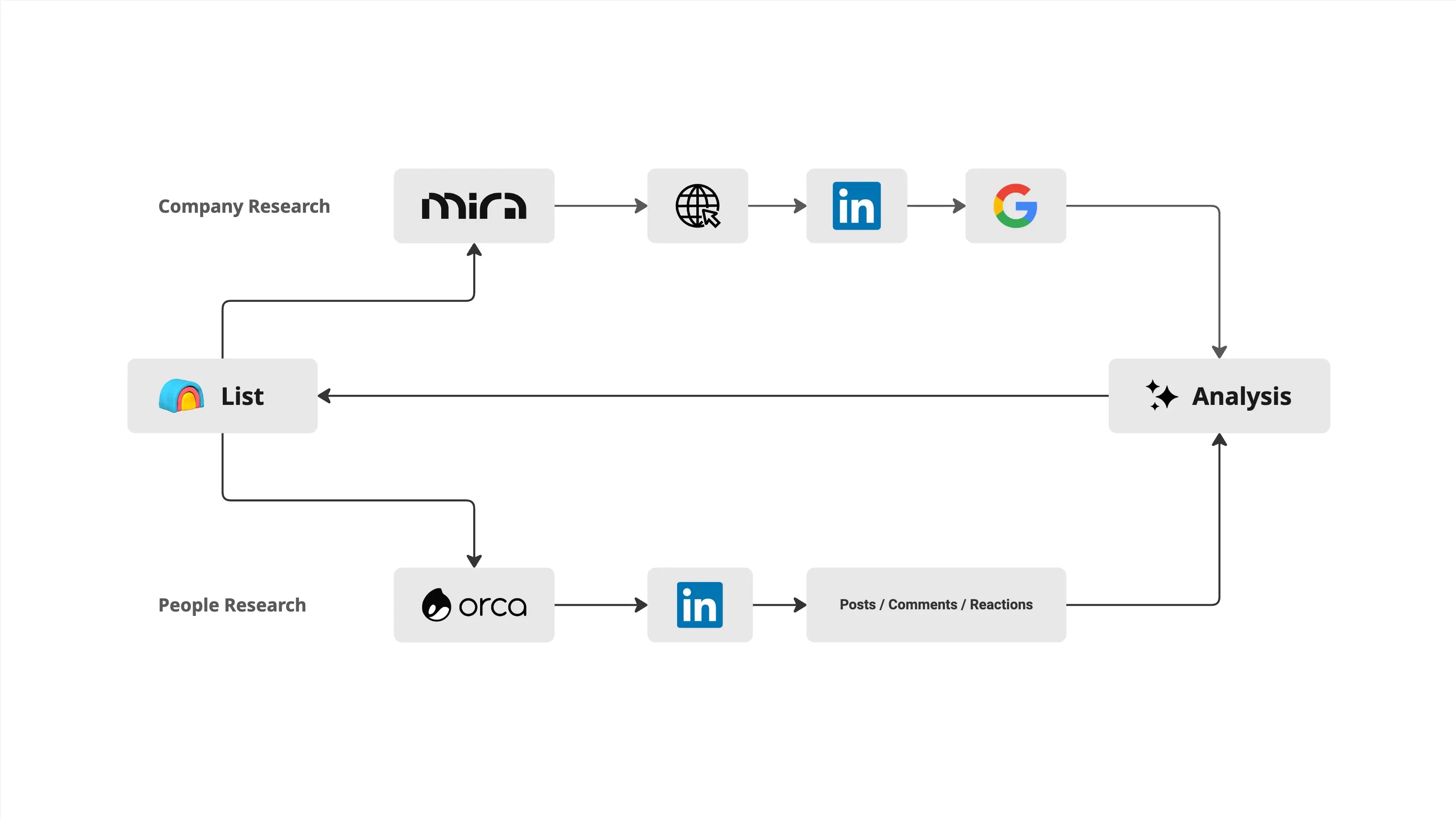
I pulled the attendee list from the conference website. All the system needs for each person is a company domain and a LinkedIn URL.
From there, two tools take over.
For company research I use Mira, my open-source multi-agent AI system. You give it a domain and it sends out agents to research the company through their website, LinkedIn, and Google searches. It comes back with structured data: what the company does, who they sell to, whether they're recently funded, whether they're using AI, and more.
For people research I use Orca, also my open-source project. It's an AI agent for deep LinkedIn profile analysis. You give it a LinkedIn URL and it gathers posts, comments, and reactions, then reasons over all of it to extract insights: what the person is focused on, what challenges they're dealing with, how they communicate, what they care about.
Both tools run in parallel for every row in the list.
The Result
Everything flows back into one table in Clay. For each person I can see:
- Is their company B2B, recently funded, using AI, high-ticket
- What the person is currently focused on
- What challenges they're dealing with
- What they post about and how they communicate
This is what lets me decide who is relevant and how to approach them. Not based on a job title, but based on what's actually happening with them right now.
Ten rows take a few minutes to run. A full conference list takes longer, but it's fully automatic. By the time I'm done, I have a research table I can filter and sort however I want.
Why This Changes How You Prepare
The usual outcome is knowing exactly who to reach out to before the conference even starts. You can send a message that references something specific, show up to a conversation already knowing the context, and spend your time on the people who actually fit your criteria.
But sometimes the most valuable outcome is realizing there's nobody you need to meet and skipping the trip entirely. That's also useful information.
It Works for Any List
I used a conference for this, but the system is not specific to conferences. The same approach works for any list of people and companies you want to research: investors, prospects, potential hires, competitors.
If you have a list and a reason to research it, this system handles the work.
Both Mira and Orca are open-source and standalone. You can use them with Clay like I did here, or integrate them into whatever system you're already using.